
The best time to see orcas on Vancouver Island is summer, from June to September. Transient (Bigg’s) orcas can show up in any month, and the resident orcas of the north island gather in Johnstone Strait from mid-July. If you plan a week on the coast, pick a base with the water on your doorstep and give yourself several days. Orcas are wild animals that keep their own schedule, and a longer stay gives you more chances. At Qualicum Breeze Resort you can walk down to a private beach, launch a kayak and watch the Strait of Georgia change through the day.
TL;DR
- Peak orca season on Vancouver Island: roughly June to September. The official handbook of the International Whaling Commission (IWC) says British Columbia viewing peaks between April and October, and tours generally run May to September.
- North island residents: best from mid-July to mid-September around Telegraph Cove and Johnstone Strait.
- Time of day: no consistent winner. Calm mornings and evenings are pleasant, but the whales decide.
- Plan for several days, not one afternoon: sightings are never guaranteed, so a base on the water with other things to do keeps the trip good whatever the whales do.
Table of Contents
- When is orca season on Vancouver Island?
- Two kinds of orca, two kinds of timing
- Does the time of day matter?
- Where to see orcas from a Qualicum Beach base
- Watching responsibly
- What to plan around the orcas
- Perspective: why we tell guests to stay longer
- Where to stay for whale watching
- Orcas elsewhere: when the island is not your only option
- FAQ
- Sources
When is orca season on Vancouver Island?
Orcas are found in every ocean, so “orca season” always means a season in one place. Around British Columbia, the IWC Canada profile says killer whale watching runs year-round with a peak between April and October because of weather. It adds that tours generally operate from May to September, when sea conditions are most favourable.
A month-by-month view for the island looks like this:
| Period | What to expect |
|---|---|
| November to March | Quiet season. Transient orcas can appear at any time of year, and tours are fewer. |
| April to May | Season opens. Destination Vancouver says the whale-watching season there runs roughly April to October. |
| June to September | Peak. Salmon and baitfish move into the water, and whale-watching is at its busiest. |
| Mid-July to mid-September | Best window for resident orcas in the north (Telegraph Cove, Johnstone Strait). |
| October | Season winds down, though sightings still happen. |
The season is tied to food. Destination Vancouver explains that the whale-watching season there runs roughly April to October, with peak months May to September, because salmon and baitfish move into the Salish Sea. The Salish Sea is the inland waterway that includes the Strait of Georgia, the water along Vancouver Island’s east coast.
Two kinds of orca, two kinds of timing
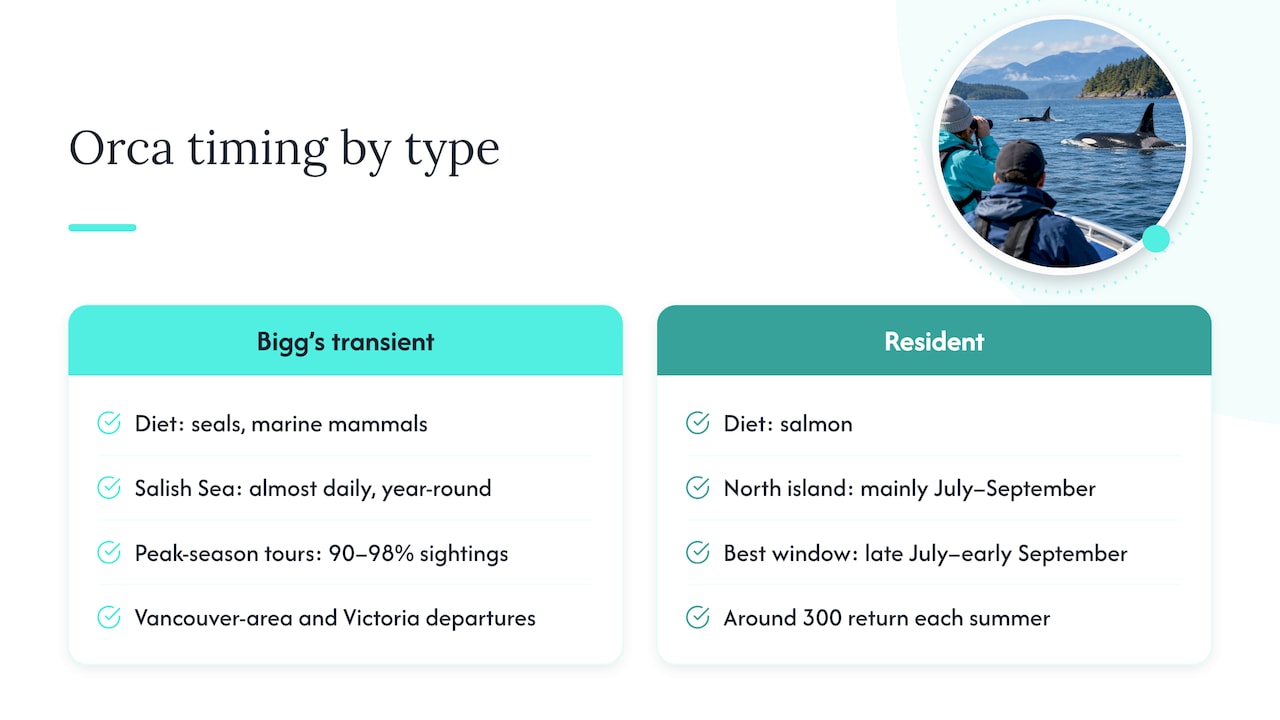
The orcas off this coast are not all the same animals. The IWC handbook describes fish-eating “resident” and mammal-eating “transient” ecotypes on North America’s West Coast. An ecotype is a group that has adapted to a particular diet and lifestyle. It matters for your planning because the two groups behave differently.
Bigg’s (transient) orcas roam widely and hunt seals and other marine mammals. In the Salish Sea they are the most dependable orcas, present almost every day of the year, with tour sighting rates of 90 to 98% in peak season from Vancouver-area and Victoria departures. The same source treats Telegraph Cove and Johnstone Strait as the place for resident orcas from mid-July to mid-September, with around 300 returning each summer.
Resident orcas eat salmon and follow the runs. The Whale and Dolphin Conservation (WDC) responsible whale watching guide lists northern Vancouver Island (Telegraph Cove, Alert Bay, Campbell River, Port McNeill) as a key orca area, with orcas mainly seen from July to September. It also gives humpbacks as May to September.
For most visitors the takeaway is simple. If you want the best odds of any orca, go between June and September. If you want the famous north island residents, aim for late July through early September.
Does the time of day matter?
Less than you would think. Operators who run these tours disagree with each other, which tells you there is no reliable rule:
- Wild Whales Vancouver says there is no better time of day. Pods may be near the city in the morning one day and out of range by afternoon.
- A Campbell River operator, Big Animal Encounters, explains that mornings have fewer sighting reports because fewer boats are out. Afternoons benefit from those morning reports, but whales can travel great distances and disappear.
- Destination Vancouver adds that mornings and evenings are often more comfortable because the water tends to be calmer.
So choose the departure that suits your day. If you are watching from the shore, calm light in the early morning and evening is lovely for scanning the water, and you will see seals, eagles and other marine life while you wait.
Where to see orcas from a Qualicum Beach base
Qualicum Beach sits on the Strait of Georgia, roughly midway up the island’s east coast. That makes it a practical place to stay for a week of marine wildlife viewing, because you can combine local days on the water with a longer day trip north. A Wanderlog route estimate puts the drive from Qualicum Beach to Telegraph Cove at about 4 hours, with Campbell River roughly an hour from Qualicum Beach on the way.
A sensible plan for a summer week:
- Arrive and settle. Spend the first evening on the beach and learn the tides.
- Local water days. Walk the shoreline, paddle on calm mornings and watch for marine wildlife from the beach.
- One organised whale-watching day. Book a boat tour in the Strait of Georgia or head north for Johnstone Strait if you are there between mid-July and mid-September.
- Everything else. Hiking, golf and fishing fill the days the whales do not cooperate.
The Qualicum Beach vacation guide and our things to do page cover the rest of the area. Our directions page helps with the drive in.
Watching responsibly
The Southern Resident population is small. WDC notes it numbered only 75 individuals as of July 2023, and it asks travellers to research boat operators carefully and to consider land-based viewing as a lower-impact option. The Whale Museum on San Juan Island says shore viewing is the least intrusive way to watch, and it notes a legal 100-yard distance rule from marine mammals in its area.
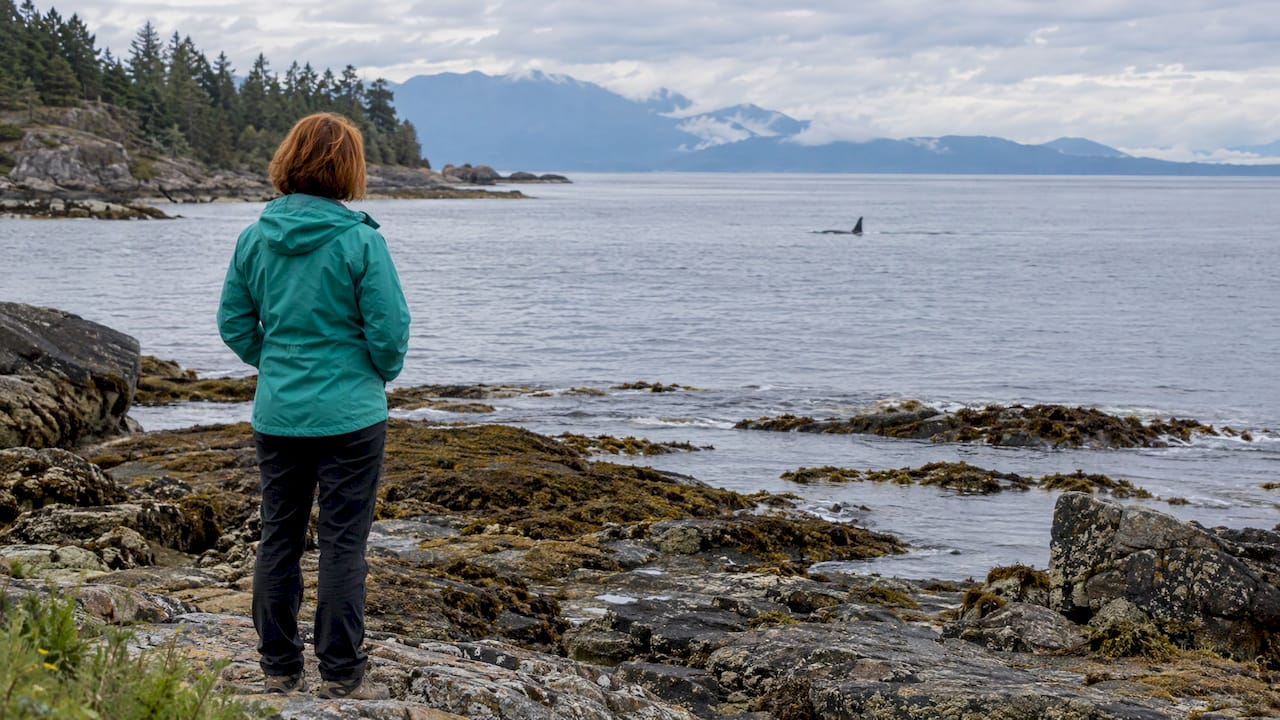
If you paddle, keep well back from any whale you see, never try to approach or follow, and let the animals pass. Rules differ by place, so check the current regulations from Fisheries and Oceans Canada before you set out. Strong tidal currents, dense fog and high wind can arise on the water at any time of year, as BC Parks warns for Johnstone Strait, so check the forecast and tides before any paddle.
What to plan around the orcas
Families. Children do better when the trip is not built on one sighting. A private beach with tide pools, beachcombing, bonfires, and clam digging and oyster picking gives them something to do on the whale-free days. Our clam digging guide explains how it works here.
Couples. Summer evenings by the water are the point. An oceanfront hot tub and a quiet beach suit a romantic trip, and our Honeymoon Beachfront Suite is made for it.
Anglers. Salmon are the reason both the resident orcas and the fishing season come alive in summer and early fall. The fish that draw orcas into the north island draw anglers to the coast too. Our fishing information page is the place to start.
Adventurers and golfers. The area has hiking trails and golf courses within easy reach, so a day that begins with a morning on the water can end on a fairway or a trail. See our activities page.
Perspective: why we tell guests to stay longer
We get asked about orcas a lot, and our honest answer is always the same: stay long enough to give yourself a chance.
Wild animals do not keep appointments. If your whole trip hangs on one boat ride on one afternoon, you are gambling. If you are here for a week, you can take a boat tour on the best-looking day, spend other mornings on the beach, paddle when the water is flat and still have the hot tub waiting at night.
That is why we built the resort around privacy and space, a country inn feel with condominium-style comforts. Full kitchen options mean you can cook the salmon you caught. The private beach means the shoreline is right outside your door. Our central spot on the island means Campbell River, Cathedral Grove and the golf courses are all an easy day out.
Come for the whales if you like. You will probably leave remembering the tide pools, the bonfire and the quiet.
Carolyn
Where to stay for whale watching
When you choose accommodation for marine wildlife viewing, these are the things that matter most:
- Water access. Being able to step onto the beach, rather than drive to it, turns spare minutes into wildlife-watching time.
- Room to spend several days. A full kitchen and space to spread out make a week comfortable for a family, and a suite or log home gives you that.
- A central position. Some of the best viewing is a day trip away, so a base in the middle of the island opens up both the south and the north.
- Things to do when the sea is quiet. Kayaking, fishing, hiking and golf all count.
This is what we offer at Qualicum Breeze Resort. We are a beachfront resort on a private beach, with oceanfront hot tubs, suites and log homes, and kayak rentals. Choose the Oceanfront Duplex Cottage, the 2 Bedroom Beachfront Suite or the Oceanfront Log Home, all bookable from our home page. If you are planning a longer season on the island, our Two Bedroom Suites are available as monthly rentals, from $2,000 per month.
Groups can also look at our destination weddings and reunions page for a family gathering on the beach.
Orcas elsewhere: when the island is not your only option
If you are comparing destinations, the timing changes a lot. Northern Norway’s orca season runs from late October to late January, according to a 2026 Norway guide. Alaska’s resident orcas can be seen year-round, with peak viewing in Seward and Kenai Fjords in May and June. Vancouver Island’s summer season is a good fit if you want warm weather, long evenings and beach time in the same trip.
FAQ
What is the best month to see orcas on Vancouver Island?
July, August and September are the most reliable months, especially for the resident orcas of Johnstone Strait, which are best seen from mid-July to mid-September. Bigg’s orcas can be seen in any month, with sightings far more frequent in summer. June and October are good shoulder months with fewer visitors.
Can I see orcas in winter?
It is possible, because transient orcas are present in the Salish Sea nearly every day of the year, but few tours run and sea conditions are rougher. The IWC says tours generally operate from May to September. For the best odds, plan for summer.
Is morning or afternoon better for orca watching?
Neither is reliably better. Operators disagree, and whales travel long distances in a day. Pick the departure that suits your schedule, and expect calmer water in the morning and evening.
Can I watch orcas from shore?
Yes, and conservation groups describe land-based viewing as the least intrusive way to watch. You will not get the odds of a boat tour, so bring binoculars, check the tides and be patient. Many guests combine shore watching with one boat tour during a longer stay.
Where should I stay for whale watching on Vancouver Island?
Choose a base on the water, with enough space for several days, that is central enough to reach both the south and north island viewing areas. Qualicum Beach on the Strait of Georgia fits that, and you can see our stay options to find the right suite or home.
Sources
- Canada | Whale Watching Handbook (IWC)
- Killer Whale | Whale Watching Handbook (IWC)
- Whale Watching Season in Vancouver | Destination Vancouver
- Best Places to See Orcas & Killer Whales Near Vancouver, BC
- Responsible Whale Watching (WDC, 2024)
- Frequently Asked Questions | Wild Whales Vancouver
- Best Time of Day for Whale Watching: Morning or Afternoon?
- Qualicum Beach to Telegraph Cove drive | Wanderlog
- Whale Watching in the San Juans | The Whale Museum
- Cormorant Channel Marine Park | BC Parks
- Where and when to see whales and orcas in Norway
- Alaska Whale Watching | Travel Alaska
